
Tuscola VINELink Custody Coverage
MI-VINE is Michigan's free and confidential victim-information and notification service. It is available to victims, families, and the general public through VINELink, its mobile application, and 800-770-7657. Official state materials describe around-the-clock access and event notices that can include release, transfer, escape, and death. The service relays data from a contributing custody agency. It does not create the jail, prison, or court record behind the event.
For Tuscola County, VINELink can be relevant to a participating county-jail record and to MDOC custody. Do not turn statewide availability into a promise that every Tuscola booking appears. Open the specific result and read the supplying agency. If the agency is Tuscola County Jail, Sheriff Ryan Robinson’s office remains the source for the physical release entry. The official jail page has no public locator. If the agency is MDOC, OTIS and MDOC records supply the prison, parole, or discharge context.
The official MI-VINE page describes the state's access and notification scope.
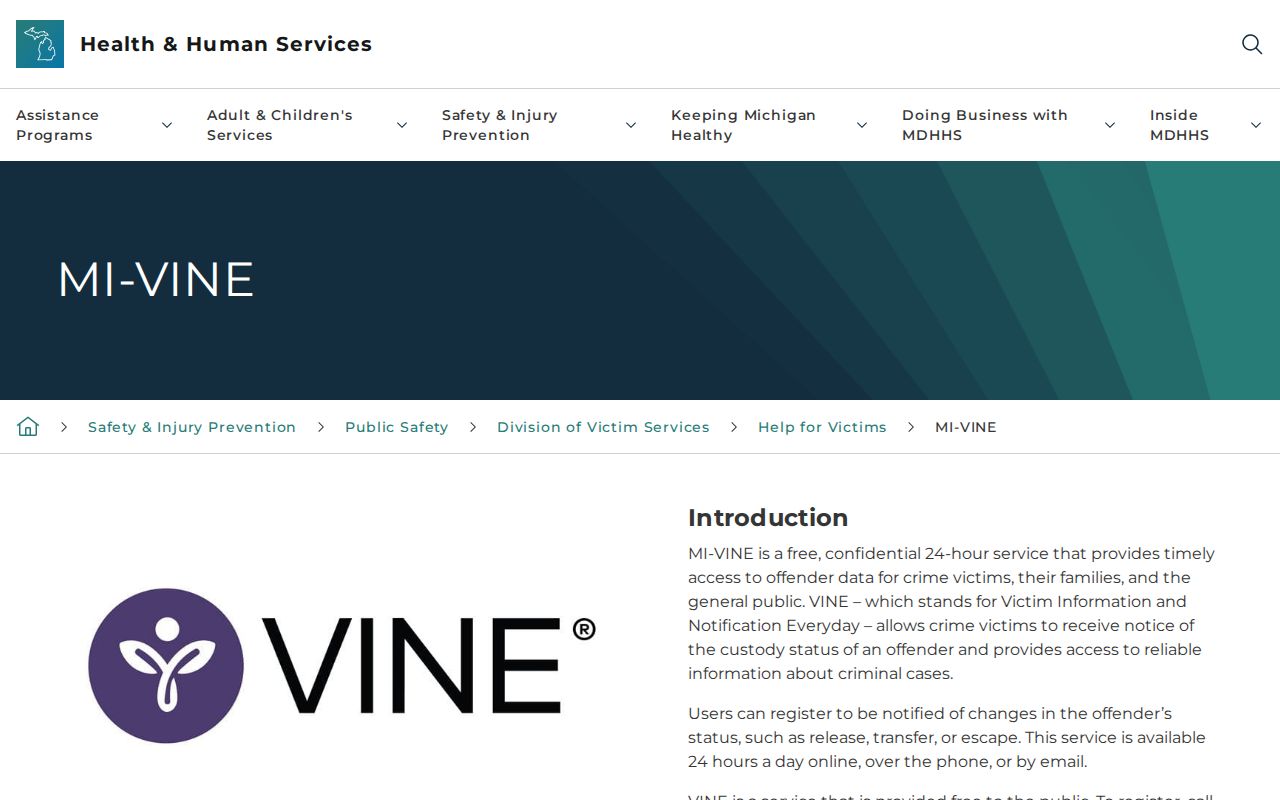
The state page establishes the program's role. The matched VINELink record still controls whether one Tuscola County custody episode is available for search or alerts.
Search Tuscola Inmates on VINELink
Search one person at a time. Begin with the person's name and add an available booking or offender identifier. Names alone can create false matches, especially when spelling, aliases, or common names overlap. Check the supplying agency, identifying details, and custody status before selecting a record. Preserve the exact wording and date of any released result.
- Open VINELink and select Michigan.
- Choose the custody search rather than treating a general web result as the record.
- Enter the first and last name, plus a booking or offender ID when available.
- Compare identifying details and the supplying agency across possible matches.
- Open the correct record and read its current custody status and displayed event data.
- If the result says released, note the event date and then confirm its meaning with the Sheriff or MDOC.
The Michigan VINELink search is the official entry point captured for a specific-person lookup.
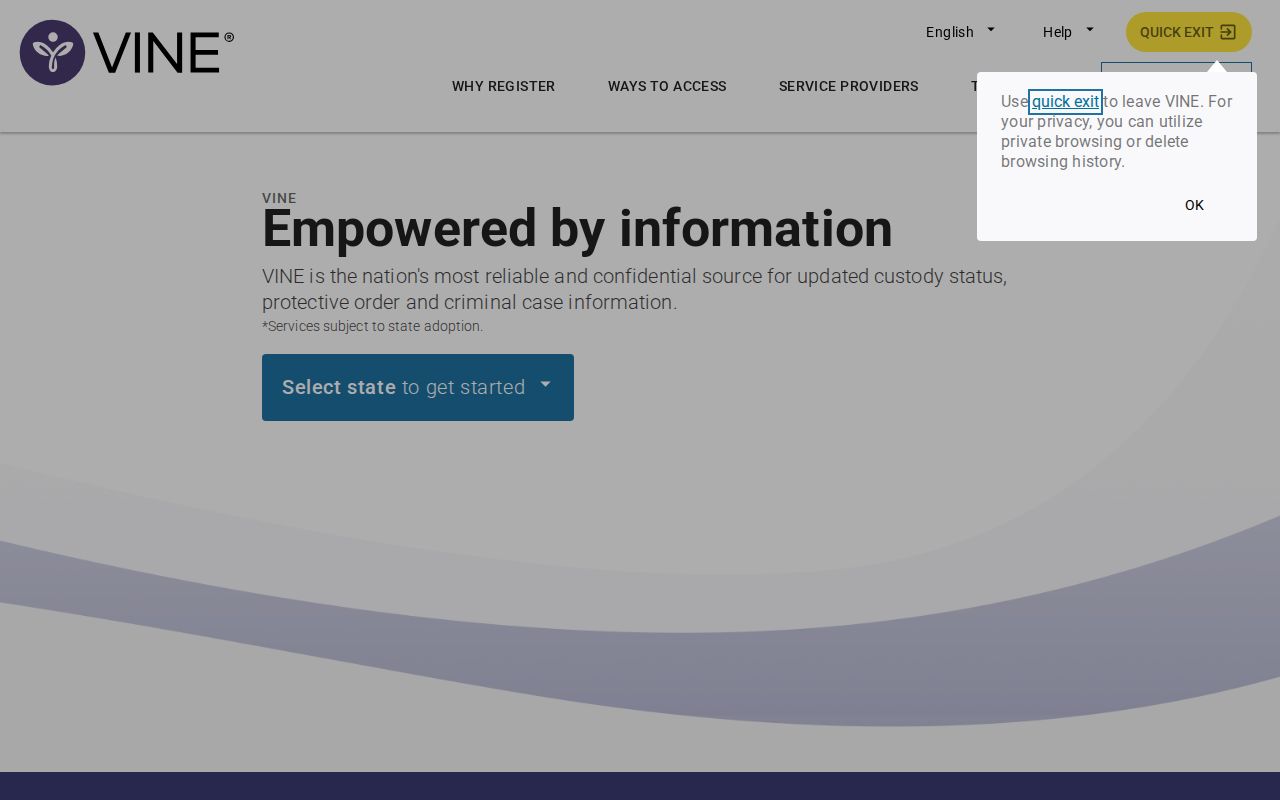
The search screen is a starting point, not proof that Tuscola County participates for every booking. A missing result can reflect spelling, booking lag, transfer, participation, retention, or a record that belongs in another system.
Note: Record “not located” with the search date and terms; never convert a VINELink no-result into proof of release or no custody.
Tuscola VINELink Result Fields
A VINELink result should be read as a custody-service record from the named supplier. Michigan research supports current custody status and notifications for events such as release, transfer, escape, or death. The available identifier may be a booking or offender number. Display can vary by agency, so the table below explains the supported use of each core item rather than promising a fixed Tuscola County screen.
| Result item | How to read it |
|---|---|
| Name and available identifier | Supports a match when compared with known details; a name by itself is not enough. |
| Supplying agency | Shows which custodian reported the status and which office should confirm it. |
| Current custody status | States the status carried by that contributing record at the time viewed. |
| Release or transfer event | Signals a reported change but may not explain the legal basis or destination. |
| Event date or notice time | Dates the service event; it may differ from a court order or agency processing time. |
| Notification options | Shows the channels available for that record, such as phone, text, or email. |
A release alert is not a release sheet. It may not distinguish bond, time served, sentence completion, transfer, or another legal outcome. For a Tuscola jail record, the Sheriff's custody entry can provide the physical departure and broad disposition. The 71B District Court can supply the local bond, dismissal, sentence, probation, or other public court event. For an MDOC record, OTIS current status and Date Paroled may add prison-release context.
Register Tuscola VINELink Release Alerts
Registration starts from the correct custody record. Select only the channels that can be monitored reliably. Phone alerts require an acknowledgment process. Text and email work differently. The service may be delayed or unavailable, so save the supplying agency's direct contact route as a second method. Keep any notification PIN private.
- Open the matched in-custody record and choose notification registration.
- Select phone, text, email, or a combination offered for that record.
- For a phone alert, create a four-digit personal identification number, or PIN.
- When the automated call arrives, enter the PIN followed by
#to acknowledge it. - Expect calls to repeat until acknowledged or for up to 24 hours under the official brochure instructions.
- For text or email, watch for one notice per status or court-event change and confirm important events directly.
The official MI-VINE brochure says phone notifications repeat because the system needs acknowledgment. Text and email do not use the phone PIN. A phone number or email address may change, and service limits can affect delivery. Update the registration when contact information changes and do not treat silence as proof that custody stayed the same.
Michigan's Two Release Alert Layers
Michigan maintains two related but distinct notification paths. The public can self-register through VINELink for an available participating custody record. That registration can report routine custody events. Eligible registered victims who seek added MDOC prison or parole-hearing and decision notices use MDOC Crime Victim Services and its Prison Notification Request Form. That second path is not a general public case-note service.
Crime Victim Services can be reached at 877-886-5401 for its official process. Eligibility and registration requirements apply. A general VINELink registration does not automatically enroll someone in every MDOC victim-notification notice. Likewise, an MDOC victim-notification registration should not be described as a public locator for all Tuscola County releases.
- VINELink self-registration
- A public notification choice tied to an available participating custody record.
- MDOC Crime Victim Services
- An added official notification route for eligible victims concerning specified prison and parole events.
- Phone PIN
- A four-digit code used to acknowledge a VINELink automated call, followed by the pound key.
- Text or email alert
- A message channel that does not use the phone PIN and generally sends one notice per change.
Keeping the two layers separate prevents missed registration steps and false promises. It also keeps a county-jail alert distinct from an MDOC parole process.
No Tuscola VINELink Search Result
A no-result needs troubleshooting, not a conclusion. Recheck the spelling, aliases, and any booking or offender number. Confirm that Michigan was selected. A recent booking may not have reached the service yet, and a transfer can place the active record under a different supplying agency. County participation and public retention can also affect display. Call the agency believed to hold the person when the record cannot be found.
If the person may have entered MDOC custody, search OTIS by offender number or name and change the default Active Offenders filter to All or the needed status. OTIS does not include county-jail-only detainees. Its public search ordinarily includes people discharged from MDOC supervision during the preceding three years, so an older state discharge can be absent. A no-result in both systems still does not prove that the person was never held or has been released.
Write down which interface was checked, the search terms, and the date. Then move to the record creator: the Tuscola Sheriff for a jail episode, MDOC for a prison or supervision episode, and the court for its order or disposition. That trail is more accurate than repeating a broad name search.
Confirm Tuscola VINELink Release Events
Record the notification date, exact event wording, supplying agency, and person identifier. Then follow the source hierarchy. For Tuscola County Jail, call 989-673-8161 and ask whether the person remains held, left for the community, or transferred. Request the jail release entry when documentary proof is needed. Compare the related court case because a release order and physical checkout can occur at different times.
For MDOC, search OTIS and change the default status filter when needed. A Prisoner result means state prison custody continues. Parolee supports a completed prison departure into supervision, especially when paired with Date Paroled. Discharged means MDOC supervision ended. An Earliest Release Date is only the first parole-jurisdiction or eligibility point and cannot confirm that release took place.
A Tuscola County person may have moved from the jail to MDOC. The county release or transfer entry documents the local episode, while OTIS documents the later state status. If dates differ, consider the sequence: court order, jail processing, transport, receiving intake, and public database update. Those are separate events. For the complete county release-record path, use the Tuscola County released-inmate search.
Tuscola VINELink Search Limits
VINELink is not the BOP Inmate Locator and is not ICE's Online Detainee Locator System. A federal prison record should be checked through BOP. Released or Not in BOP Custody means only that BOP no longer holds the person; state, immigration, or another form of custody may remain. An immigration record belongs in ICE channels, and a county-jail transfer under an immigration detainer is not a community release.
The Michigan Public Sex Offender Registry is also separate. It covers people with a statutory duty to register, not all released people. Its absence cannot answer an ordinary custody or release question. Use a registry only for the limited status it was built to report, never as a substitute for the Tuscola Sheriff, MDOC, VINELink, or court record.
Finally, an automated event notice cannot guarantee timing. Direct emergency help remains separate from notification registration. When safety or a legal process depends on the event, contact the supplying agency and preserve the official response or record. VINELink adds a useful alert layer, but the originating office supplies the controlling context.