
Tuscola Projected and Actual Release
A projected date is a planning or sentence-computation field. An actual release date records a completed departure. Michigan’s public prison terms are more precise: the Earliest Release Date, or ERD, marks the point when the Parole Board first obtains jurisdiction in an eligible case. The Maximum Discharge Date is the outside prison date on the controlling sentence if parole is not granted, subject to a valid sentence calculation.
Neither is a reservation for the exit door. An elapsed ERD can coexist with a Prisoner status after parole denial, reconsideration, misconduct, or other lawful sentence circumstances. A Parolee status and Date Paroled are stronger proof that the person left prison. Discharged means that later MDOC supervision ended.
A Tuscola court date is different again. The 71B District Court handles misdemeanors and early felony stages, while the 54th Circuit Court handles a felony after bind-over. Bond, dismissal, time served, or a sentencing entry can supply the legal basis for release. The Sheriff still must process departure and check for another warrant, hold, or transfer. That is why a court order may precede the jail’s release timestamp.
Find a Tuscola Projected Release
Start by naming the custodian. OTIS covers MDOC prisoners, parolees, felony probationers, and recent discharges. It does not cover a person held only at Tuscola County Jail. Sheriff Ryan Robinson’s office publishes no jail roster or projected-date portal on the pages reviewed. County cases require the court judgment, the Sheriff’s custody information, and any record of a hold or transfer.
- Ask whether the person is in Tuscola County Jail, MDOC custody, federal custody, or another system.
- For MDOC, open OTIS and search by offender number or by name with identifying fields.
- Read present status, ERD, Maximum Discharge Date, and Date Paroled when shown.
- For a jail-only sentence, obtain the judgment, jail-credit calculation, and Sheriff release entry.
- Check the docket for an amended judgment, bond order, consecutive term, or other order.
- Confirm completed departure with the agency that held the person.
The OTIS search screen includes offender number, name, age, sex, race, status, and identifying-mark fields.
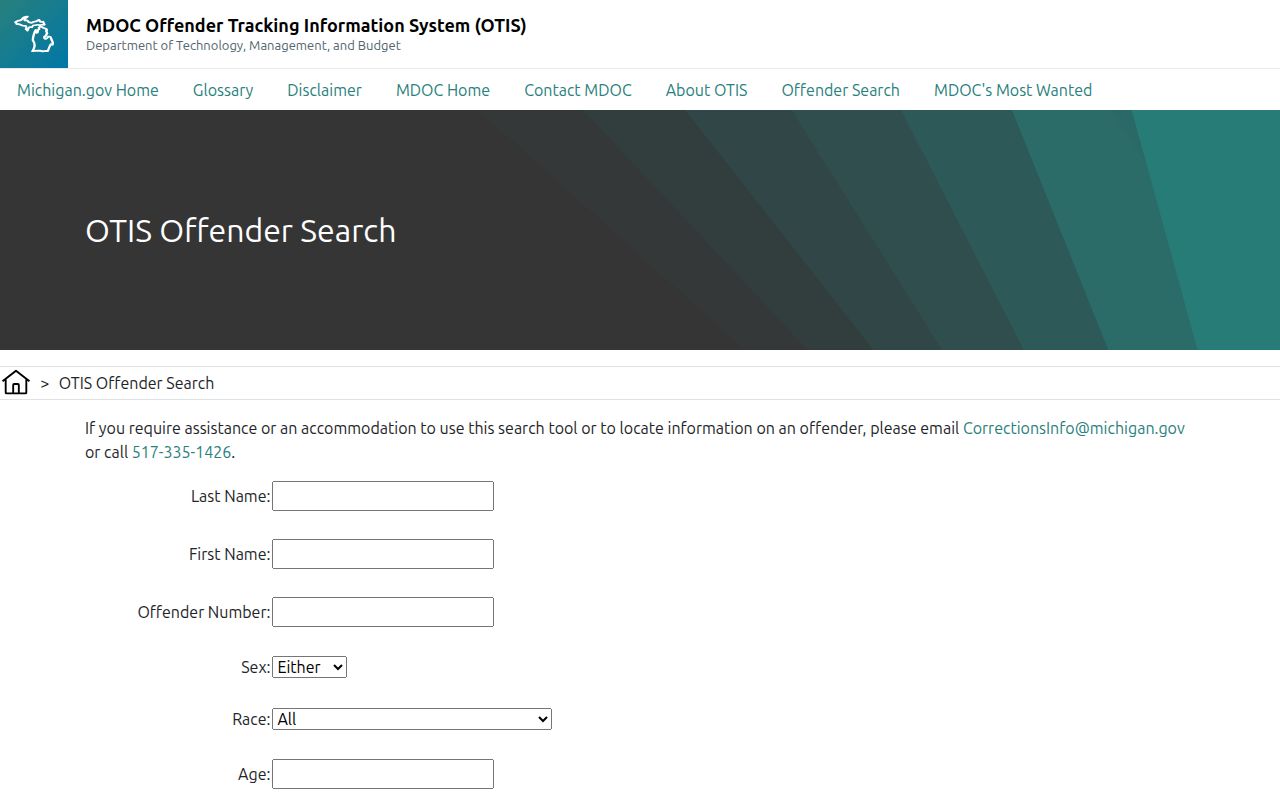
The status selector matters. Active Offenders is the default, while All and Discharged reach records relevant to people who may have left supervision.
Open the complete OTIS detail after finding a likely match. Compare the offender number and other identifiers before reading the dates. Names alone can join the wrong person to a sentence. If a Tuscola name is absent, remember that OTIS removes most discharged records from public search after three years and excludes jail-only cases. A no-result is not a release calculation.
Michigan Release Date Computation
Michigan does not use a universal rule that each prisoner serves about 85 percent. Under modern Truth in Sentencing, covered prisoners serve the entire court-imposed minimum in prison before parole consideration. Michigan sentences can have separate minimum and maximum terms, so the minimum is not a fixed percentage of the maximum.
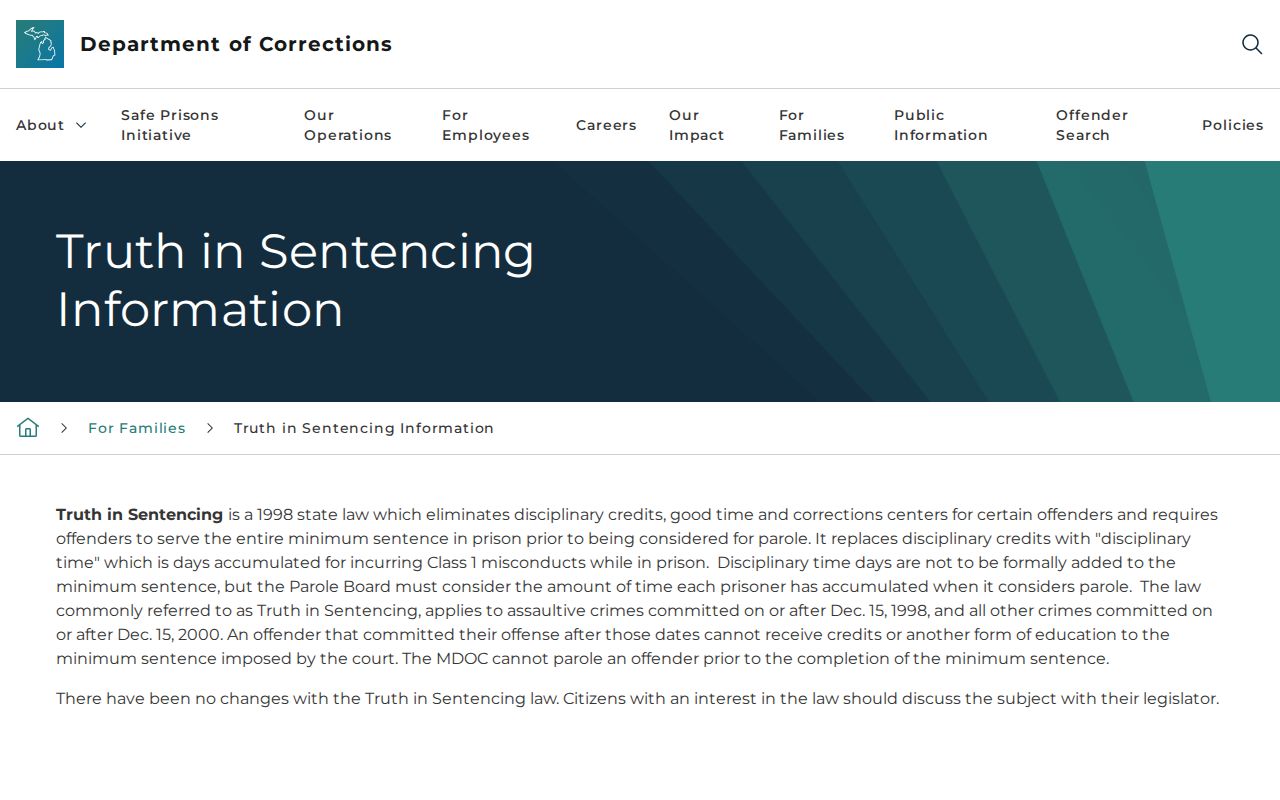
The state says Truth in Sentencing eliminated good time, disciplinary credits, and corrections-center placement for covered offenses. It replaced sentence-reducing credits with disciplinary time for Class I misconduct. Disciplinary time is not formally added to the minimum, but the Parole Board must consider it. The framework applies to specified assaultive crimes committed on or after December 15, 1998, and other crimes committed on or after December 15, 2000.
The MDOC Truth in Sentencing explanation presents the whole-minimum rule and disciplinary-time treatment.
This statewide rule applies to MDOC computation, not a Tuscola county-jail-only sentence that never enters state prison jurisdiction.
Parole eligibility also does not compel release. MCL 791.234 defines when the Board obtains jurisdiction for eligible sentences, while MCL 791.233 includes the standards for a grant. Some crimes and sentence types have their own restrictions. Read the actual judgment and statute instead of assuming that an ERD requires the Board to approve departure on that date.
Tuscola Historical Credit Cases
Older Michigan sentences require careful date work. MDOC’s glossary says eligible disciplinary-credit cases generally advanced parole eligibility by five days per month, plus two more days for exceptionally good behavior, with an annual cap of 84 days. People convicted for crimes committed after April 1, 1987 generally do not earn traditional good time. Some older eligible offenses used escalating monthly deductions and possible special good time.
Statutes control the result. MCL 791.233(1)(d) bars parole for a disciplinary-time prisoner until the court-imposed minimum is served. MCL 791.234 begins Board jurisdiction after the minimum for an indeterminate disciplinary-time sentence and aggregates consecutive minimums and maximums where required. MCL 800.33 governs historical good time and credits, while MCL 800.34 defines disciplinary time.
Do not apply one person’s credit scheme to another. The offense date, controlling sentence, and whether terms run together or one after another must all be known.
Credit language is especially easy to misread in an old docket. “Good time,” “disciplinary credits,” and “disciplinary time” are not interchangeable. Good time and disciplinary credits can affect older eligible computations. Disciplinary time under modern rules is information the Board must consider and is not a simple number subtracted from the minimum. When the public record does not identify the governing scheme, MDOC and the sentencing court are the proper channels.
Tuscola Release Date Changes
Public dates can change or fail to predict the actual exit because several distinct events affect custody. A court can amend a judgment. A new sentence can run consecutively. The Parole Board can grant, deny, or defer release. A detainer, which is another agency’s request for custody, may turn departure from one facility into transfer rather than community release.
| Factor | Effect | Record to check |
|---|---|---|
| Parole denial | ERD passes without release | OTIS and Board process |
| Disciplinary information | May affect review or suspend processing | MDOC record |
| Amended judgment | Changes the controlling sentence | Sentencing court |
| Consecutive terms | Aggregates terms as law requires | Judgment and MDOC computation |
| Detainer or hold | Can produce transfer, not community release | Holding and receiving agencies |
| Post-grant processing | Physical departure occurs later | Date Paroled and status |
MDOC states that parole-release processing after a grant requires at least 28 days. Adverse information or misconduct can suspend parole during that period. A grant date therefore is not the physical release date.
A database update can add another gap. The court enters an order, jail staff or MDOC completes processing, transport may occur, and the public system later refreshes. Different timestamps can all be accurate because they refer to different steps. Write down the label next to each date rather than choosing the earliest date as “the release.”
Tuscola Jail Release Calculations
A pretrial detainee has no sentence-based projected release date. Bond may be posted or a court may authorize release, yet another warrant, hold, or transfer can delay departure. The court event states legal authority. The Tuscola Sheriff’s custody entry shows whether and when staff completed physical checkout.
For a jail-only sentence, use the judgment, the jail-credit calculation, and the Sheriff release record. No Tuscola-specific public jail good-time rule or weekend-release policy was found in the research. Importing a policy from a different Michigan county would create a false date. Call the Sheriff at 989-673-8161 for the custody status, and use a narrow FOIA request when documentary proof is needed.
Note: The phrase “72 hours or less” in a county jail proposal described holding cells, not a release-date rule or public list.
If the Sheriff says the person transferred to MDOC, allow for state intake before expecting a searchable OTIS record. Bridge that period with the Sheriff transfer record and the felony judgment. A transfer is continued custody, even though the person has physically left the county jail. Federal or immigration transfer requires the receiving system rather than an MDOC projected date.
Tuscola Release Computation Channel
The safest computation channel begins with the Judgment of Sentence. Read the minimum and maximum terms, identify the controlling sentence, and determine whether multiple terms are concurrent or consecutive. Next, use the offense date to identify Truth in Sentencing, disciplinary-credit, or older good-time rules. OTIS then supplies the state’s public ERD and Maximum Discharge Date.
That sequence prevents a common error: treating arithmetic as an agency decision. ERD establishes a jurisdiction point, not a guaranteed grant. If the Board does not grant parole, the maximum discharge date remains the valid outside term, subject to amended judgments, detainers, consecutive cases, and corrections. If the dates conflict, use the sentencing court and MDOC rather than creating a new projected date.
The court record and OTIS may use dates for different tasks. The judgment defines the sentence that MDOC must compute. OTIS displays selected public fields from the corrections record. A later amended judgment may take time to appear in every interface. Keep a copy of the judgment date and amendment date, then ask the sentencing court about its order and MDOC about its computation. This preserves the line between a legal source and a corrections calculation.
The full release record and custodian-routing method appears on the Tuscola County released inmates page. It separates county release, MDOC parole, federal status, and immigration transfer.
Confirm Tuscola Release Dates
A completed prison departure is best supported by Date Paroled and a Parolee status. Discharged goes further and means MDOC supervision later ended. For county jail, ask the Sheriff whether the person remains held, left for the community, or transferred. Then compare the court order with the custody entry.
MI-VINE can send an alert for a participating release or transfer event, but the alert may not show destination or legal basis. Register through the Tuscola VINELink inmate search, then confirm the event with the agency that supplied it. Record the date, event wording, agency, and identifier. Automated notices can lag.
If the person leaves BOP or ICE rather than Michigan custody, use that federal system’s record. “Not in BOP Custody” does not rule out state or immigration custody, and an ICE no-result is inconclusive. Tuscola Sheriff records remain useful only for the county episode or transfer. They cannot establish a later federal release date that another agency created.
When sources show different dates, identify the event each one records. A court order, jail checkout, transport, MDOC intake, parole grant, and public database update can all occur on separate days without any one record being wrong.