
Tuscola Parole and Probation Compared
Parole and probation both permit a person to live in the community under stated rules, yet they arise in different ways. Parole follows an MDOC prison term. A parolee has physically left prison but remains within Michigan Department of Corrections jurisdiction. Probation is ordered by a court. It may replace confinement or follow a shorter custody event, so a probation record cannot be read as proof of a prison release.
The agency also depends on the case. MDOC Field Operations Administration supervises state parolees and felony probationers. The 71B District Court Probation Office separately handles adult misdemeanant supervision. A caller should name the court and case type before asking which office holds the record.
| Type | What came before | Tuscola source | Release meaning |
|---|---|---|---|
| State parole | An MDOC prison term | OTIS and MDOC field office | Left prison, not discharged |
| Felony probation | A felony court order | OTIS and Field Operations | Does not prove a prison stay |
| Misdemeanor probation | A 71B District Court order | District Court Probation | Does not prove jail release |
| Discharge | Completed MDOC supervision | OTIS, within its display scope | State supervision has ended |
- Parole
- Conditional community supervision after release from state prison.
- Probation
- Court-ordered community supervision that may be imposed without prison.
- Discharge
- The formal end of MDOC custody and supervision.
- Absconder
- A person reported as no longer complying with supervision contact requirements; it is not a discharge.
Verify Tuscola Post-Release Supervision
The public name-level check for state supervision is MDOC’s Offender Tracking Information System, known as OTIS. Its default Active Offenders filter can hide a completed discharge. Choose All or the status that fits the inquiry, then compare identifiers instead of relying on a name alone. OTIS covers MDOC prisoners, parolees, felony probationers, and people discharged during the prior three years. It excludes county-jail-only detainees and people sentenced only to a local jail.
- Search by offender number when it is known. Otherwise use first and last name.
- Use age, sex, race, or identifying marks to separate similar results.
- Read the label: Prisoner, Parolee, Probationer, Discharged, or one of the absconder categories.
- For a local misdemeanor, check the 71B District Court record and its probation office.
- Ask the proper office to clarify an error. Court-derived errors go to the sentencing court.
A person marked Parolee has left state prison. A person marked Prisoner has not. If OTIS shows no result, that may reflect its county-jail exclusion, three-year post-discharge window, a set-aside, or a mismatch in the search fields. It does not prove that no supervision or custody event occurred.
The date fields need the same care. Date Paroled supports completed prison departure into community supervision. Maximum Discharge Date is the outside state term, not proof that supervision ended on the day someone searched. The court docket can explain the judgment and sentence, while the MDOC record supplies the state status. When the two appear inconsistent, preserve both dates and ask the agency that created the disputed field.
Tuscola State Supervision Office
People associated with a Tuscola felony parole or probation case may be served by the local MDOC field office. Search OTIS first. The office is a follow-up channel for a status ambiguity or correction, not a public roster and not a source of private schedules or case notes.
Tuscola County Parole/Probation OfficeMDOC Field Operations Administration, Region 6
449 Green Street, P.O. Box 536
Caro, MI 48723
989-672-3760
The MDOC Region 6 directory is the official source for this listing. The regional operations office is at 816 Beach Street in Flint and uses 810-760-0902. Office hours were not stated in the research, so call before an in-person visit.
The official Region 6 directory image shows the Tuscola supervision-office route.
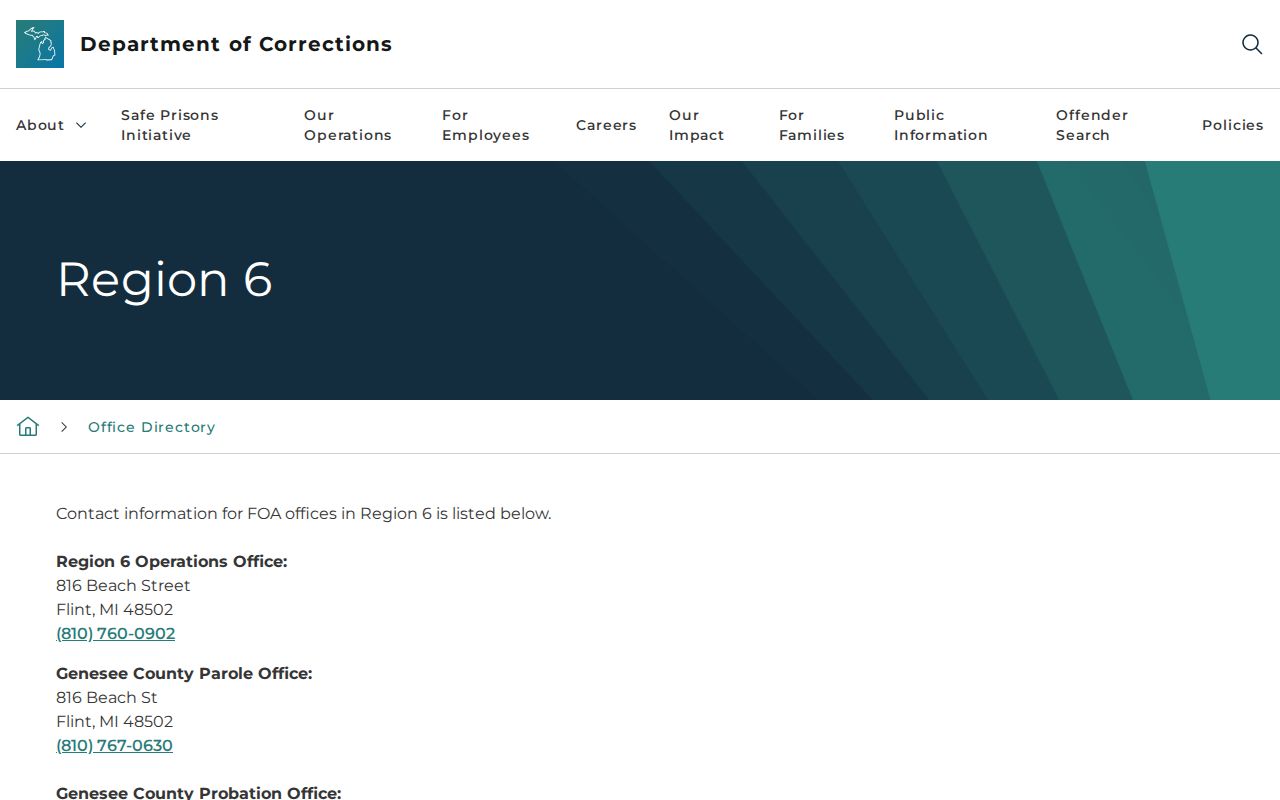
Use the local block to confirm the office and number, then state whether the question concerns parole, felony probation, or a record correction.
Tuscola Absconder Status Checks
OTIS provides separate Parole Absconder and Probation Absconder filters. An absconder label signals an unresolved supervision status. It does not mean discharge, and it does not by itself prove present imprisonment. It also should not be restated as an arrest warrant unless a competent official source supplies warrant information. Compare identity details and note which filter produced the record.
MDOC also links a Most Wanted page and publishes quarterly aggregate parole-absconder reports in its legislative reports archive. Those reports count trends. They cannot settle one person’s case. A suspected wrong label should be taken to the Tuscola field office, while a court-data issue belongs with the sentencing court.
Tuscola Court Probation Routes
Local court probation is not one office with state parole. The 71B District Court Probation Office handles adult misdemeanant cases. It is on the second floor of the courthouse and can be reached at 989-672-3810 or districtcourtprobation@tuscolacounty.org. The District Court page also identifies its Magistrate and Criminal and Traffic Division as the keeper of pending criminal and traffic filings.
The 54th Circuit Court handles felony matters after bind-over. Its Adult Probation contact is 989-672-3760, with fax 989-672-3765. That phone overlaps the state office listing, which makes the case type especially important. A person asking about a misdemeanor should say “71B District Court probation.” A felony supervision question should identify the 54th Circuit case or the MDOC record.
MiCOURT is the statewide public starting point, but its online entries do not replace the official court record. Search the correct Tuscola court and participant name. District Court covers misdemeanors and the preliminary stages of felony cases. Circuit Court covers a felony after bind-over. A probation order in one file may be missed if only the other court is searched. The County Clerk, at 989-672-3775, is the circuit-record contact when a certified or fuller court record is needed.
Note: A probation order explains legal supervision, but it does not give the jail’s physical release time or prove a prior prison stay.
Tuscola Post-Custody Programs
Tuscola’s local landscape includes more than formal supervision. The 54th Circuit Court identifies Tuscola Mental Health Court and Thumb Regional Sobriety Court. Sheriff Ryan Robinson’s office links Reach the Forgotten Jail Ministry. These contacts may help people navigate court programs, sobriety-court requirements, or faith-based support after custody, but none is a custody-status search.
Mental Health Court can accept cases from both 54th Circuit and 71B District Court. Its contact is at 440 N. State Street in Caro, with phone 989-672-3810. Thumb Regional Sobriety Court lists Jamie Foster at 989-672-1296 and jfoster@tuscolacounty.org. Eligibility, participation, and results depend on the program and court. No outcome should be promised.
This distinction matters when verifying a released person. Program participation may coexist with probation, but a program contact cannot replace OTIS, the supervising office, the court order, or the Sheriff’s custody record.
Tuscola Supervision Conditions
Conditions are the rules placed on a parolee or probationer by the responsible authority. They are case-specific. The public OTIS entry can identify status and supervisory context, but it is not an unrestricted file of appointments, reports, or daily activity. General examples should never be used to claim what applies in a particular Tuscola case.
A violation allegation does not itself show that supervision ended. The responsible court or MDOC process determines the result. Custody may resume, conditions may change, or the allegation may be resolved another way. Check the current OTIS status and the court docket, then use the field office for a true conflict. VINELink can relay a participating custody event, but the alert may not state the legal reason or destination.
Supervision and custody are also separate states. A person may live in Tuscola County on parole without appearing in the county jail. Another person may be held in jail on a new matter while an older probation case remains open. Use the Sheriff for present county custody, OTIS for MDOC status, and the court for its own order. No single label should be stretched beyond the system that published it.
Tuscola Supervision Discharge Records
Discharge means MDOC jurisdiction has ended. It is different from parole, which begins after prison release and continues until a later discharge. OTIS can show Discharged, but its public coverage ordinarily lasts only three years after the supervision end date. A qualifying conviction set aside by a court or by operation of law may also be removed from public display.
When the public entry is gone, the sentencing court and the record-holding agency become more important. Search MiCOURT with the correct court, then contact the clerk for an official document when the online docket is incomplete. A Tuscola county-jail release, state parole date, and state discharge date are separate events. The full county release-verification route is explained on the Tuscola County released inmates search.
Set-aside rules can further limit public display. OTIS removes qualifying convictions set aside by a court or by operation of law. MiCOURT also has court-participation, display-period, and protected-case limits. A missing public result should be described as not located in the interface searched on that date. It should not be turned into a claim that supervision never existed. For an older discharge, ask the correct custodian what record remains available and what lawful access limits apply.
Note: Record the exact source and status date because court orders, prison departure, supervision start, and discharge can occur on different days.